

Introduction
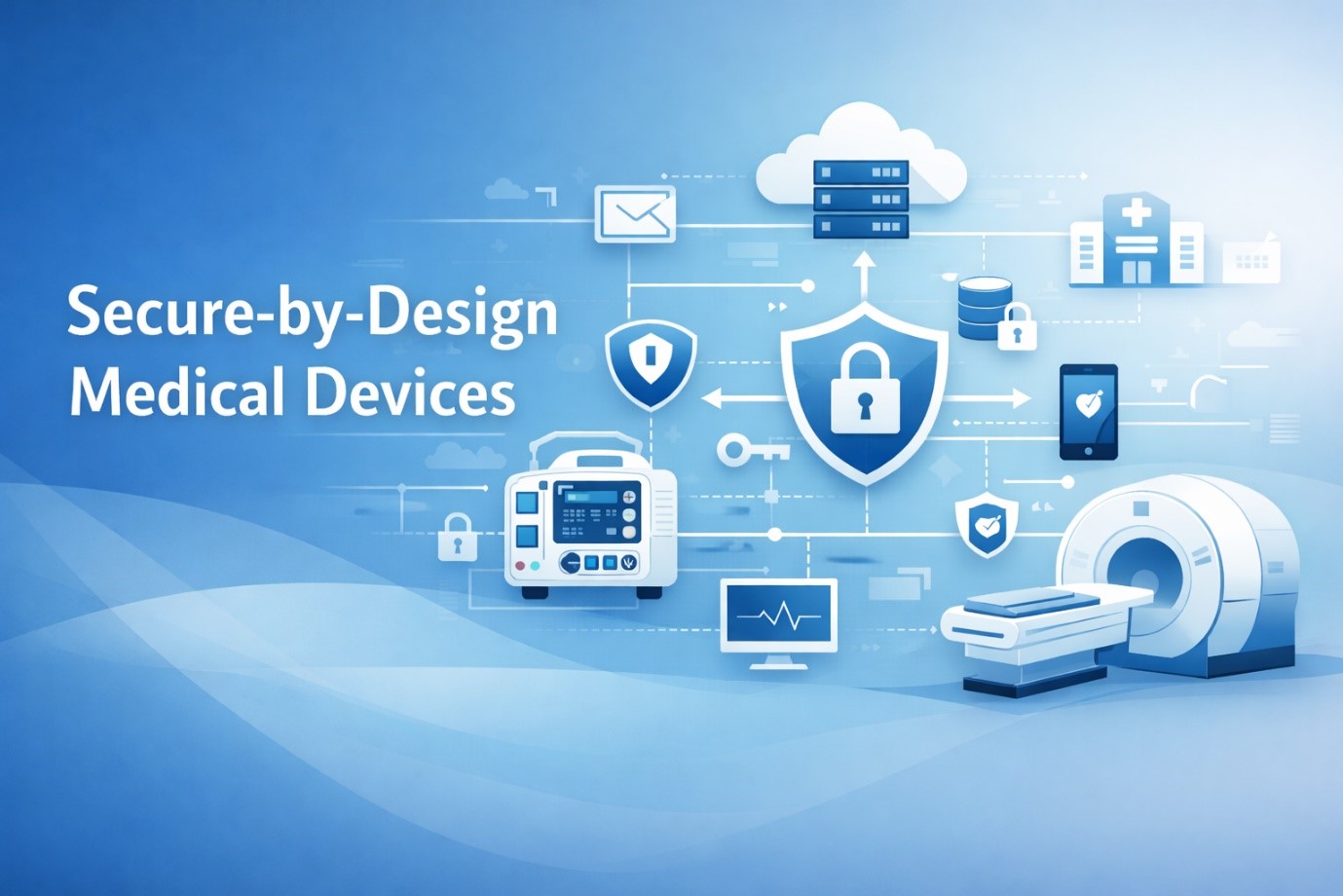
Cybersecurity for medical devices can no longer be treated as a post-development add-on. As devices become more connected—to hospital networks, cloud platforms, mobile apps, and remote service tools—security failures increasingly translate into patient safety risks, regulatory delays, and costly remediation.
Regulators now expect manufacturers to demonstrate that cybersecurity has been designed into the product from the beginning, not retrofitted before submission. Secure-by-design is no longer optional—it is foundational.
What Does Secure-by-Design Mean for Medical Devices?
Secure-by-design means embedding cybersecurity considerations into every stage of the device lifecycle, in the same way safety, usability, and reliability are addressed.
Key principles include:
- Understanding how the device can be misused or attacked
- Designing trust boundaries intentionally
- Minimizing attack surface by default
- Ensuring security controls are maintainable over the product’s lifetime
This approach reduces last-minute security gaps that often delay regulatory approval.
Security Across the Medical Device Lifecycle
1. Concept & Architecture Phase
This is where cybersecurity decisions have the highest impact and lowest cost.
Key activities:
- Identify data flows (patient data, telemetry, commands)
- Define trust boundaries between device, cloud, mobile apps, and hospital systems
- Perform threat modeling to identify realistic attack scenarios
- Decide authentication, encryption, and update strategies early
Design errors at this stage are expensive—and sometimes impossible—to fix later.
2. Development Phase
During implementation, secure-by-design focuses on consistency and discipline.
Best practices include:
- Secure coding standards
- Avoidance of hardcoded credentials
- Strong secrets and key management
- Open-source component tracking (SBOM)
- Clear separation between safety-critical and non-critical components
Security debt introduced here often becomes post-market liability.
3. Verification & Validation
Security must be verified, not assumed.
Activities include:
- Security testing aligned to device risk
- Abuse and misuse case validation
- Verification of update and recovery mechanisms
- Ensuring security controls do not interfere with safety functions
Regulators increasingly look for evidence that cybersecurity claims are tested.
4. Manufacturing & Deployment
This phase is often overlooked, yet highly sensitive.
Key risks:
- Default passwords
- Insecure provisioning processes
- Lack of secure onboarding into hospital environments
Secure manufacturing ensures devices are delivered in a hardened, known-good state.
5. Post-Market Security Readiness
Secure-by-design does not stop at launch.
Manufacturers must ensure:
- Patchability throughout the device lifecycle
- Monitoring for new vulnerabilities
- Clear processes for updates without impacting patient safety
Devices that cannot be updated safely become long-term liabilities.
Common Secure-by-Design Mistakes
- Treating cybersecurity as documentation work only
- Relying solely on penetration testing
- Designing without threat modeling
- Ignoring post-market realities
- Assuming hospital networks will compensate for device security gaps
Regulatory Alignment
Secure-by-design supports compliance with:
- FDA premarket cybersecurity expectations
- Risk management processes
- Software lifecycle controls
When design artifacts clearly show how risks were identified and mitigated, regulatory review becomes smoother and faster.
Conclusion
Secure-by-design is not about adding complexity—it is about reducing uncertainty. Medical device manufacturers who invest early in sound security design avoid costly redesigns, reduce regulatory friction, and protect patients more effectively.